Most organizations know they need to assess their AI systems. Far fewer know where to start. The topic feels big and new, so it waits. Meanwhile the models, the agents, the integrations keep shipping.
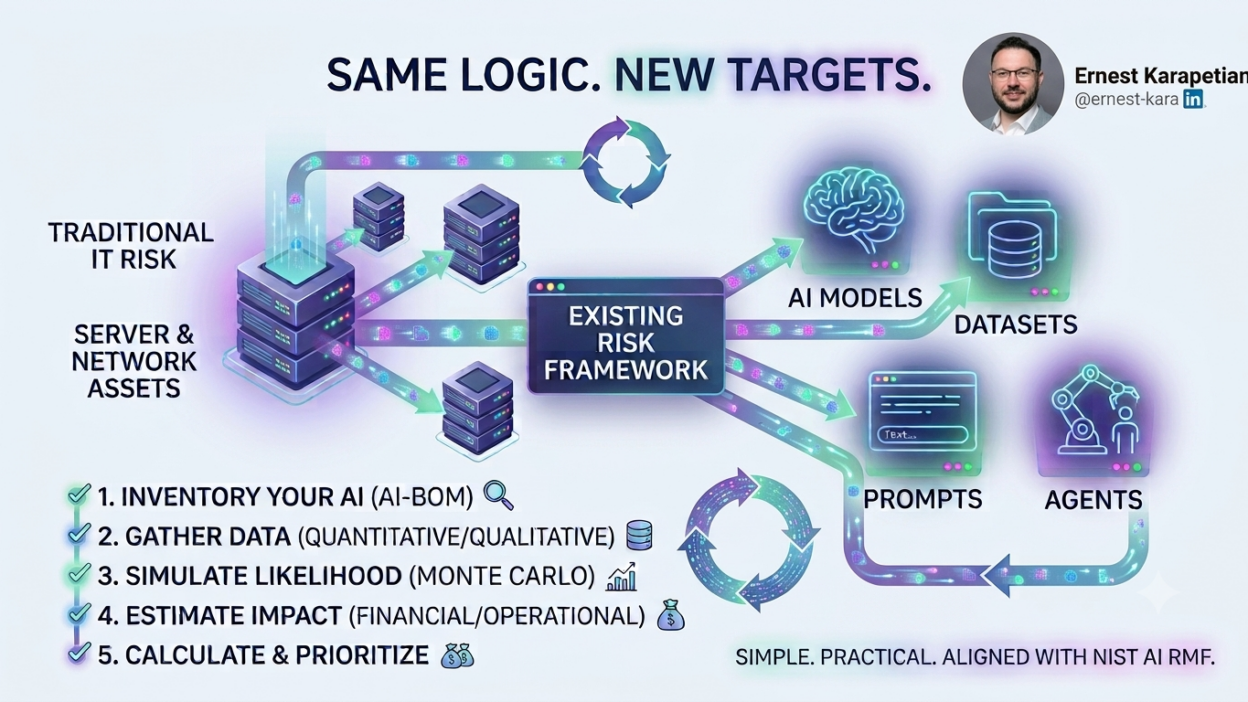
Here is the good news. You do not need a new discipline to start. AI risk assessment follows the same logic as any risk work. You find what you have. You gather data. You estimate how likely a bad event is. You estimate how much it would hurt. You calculate risk. What changes is the asset you look at and the scenarios that go wrong.
Below is a five-step way to begin. Each step maps to the NIST AI Risk Management Framework (AI RMF 1.0): the voluntary framework NIST published in January 2023.
Step 1: Start with an AI asset inventory
You cannot assess what you cannot see. So find what you have:
- Models (LLMs, classical ML models, model APIs)
- Datasets (training, fine-tuning, inference/retrieval data)
- AI-powered applications and features
- Third-party AI integrations and vendor APIs
- Prompt libraries and system prompts
- Agents and automation workflows
- Infrastructure behind the AI (vector databases, GPUs, pipelines)
Structure it as an AI Bill of Materials (AI-BOM). It is the same idea as a software bill of materials (SBOM), extended to cover models, datasets, and their provenance. This is a real direction, not a buzzword:
- CycloneDX supports a Machine Learning Bill of Materials (AI/ML-BOM) as of spec v1.5. It covers models, datasets, and configurations.
- SPDX 3.0 added formal AI and Dataset profiles to describe ML components in a machine-readable format.
- CISA and G7 partners published Software Bill of Materials for AI: Minimum Elements as baseline guidance.
- The OWASP AI-BOM project is building community guidance on what an AI-BOM should contain.
- For a single model, a Hugging Face model card is a ready-made source of metadata: intended use, training data, limitations. Pull it straight into your inventory.
One honest note. The tooling is still young. There is no push-button “AI-BOM generator” yet. You assemble the inventory from these standards plus your own asset data. But the standards give you a real format to aim at. That is where AI risk assessment starts.
Step 2: Gather data for risk analysis
Once you know what you have, gather the data that drives the analysis. The data also tells you which kind of assessment you can credibly run:
- Quantitative: numbers-based, in frequency and dollars
- Qualitative: ratings-based (high/medium/low), useful when data is thin
When usable data exists, go quantitative. It is more defensible and more useful. It hands leadership dollar ranges and probabilities instead of colored boxes. It is not automatically more precise (bad inputs still produce bad outputs), but done well it is far easier to act on and to defend. Good sources:
- Threat intelligence reports
- Industry incident and breach reports
- Internal incident data
- Red team findings
- Testing and evaluation results
More grounded data, stronger estimates.
Step 3: Use simulations for likelihood estimation
This is where it gets interesting. Do not guess likelihood as a single number. Model it as a range and simulate it. You can:
- Run Monte Carlo simulations over your estimated inputs
- Use Python libraries such as SciPy to sample distributions
- Model the frequency of attack scenarios
- Estimate probability of failure
This is the logic behind FAIR (Factor Analysis of Information Risk), the open standard for quantitative cyber risk. FAIR splits risk into Loss Event Frequency and Loss Magnitude. Then it uses Monte Carlo sampling to produce a distribution of losses instead of one fragile point estimate. If your approach already looks like this, you are doing FAIR-style analysis.
I have used SciPy this way before. I ran simulations for phishing scenarios to estimate how often they occur. The same logic maps straight to AI-specific risks. Those risks are catalogued in the OWASP Top 10 for LLM Applications (2025):
- Prompt injection (LLM01:2025)
- Data leakage / sensitive information disclosure (LLM02:2025)
- Model misuse / excessive agency (LLM06:2025)
- Hallucination-driven decisions / misinformation (LLM09:2025)
This turns assumptions into numbers you can compare.
Step 4: Estimate impact
For impact, ground the numbers in real references:
- Threat intelligence reports
- Industry breach-cost reports
- Regulatory penalty schedules
- Operational downtime estimates
Then translate them into the terms leadership cares about:
- Financial impact
- Operational impact
- Compliance impact
- Reputational impact
Step 5: Calculate risk
Now you have likelihood and impact. Calculate risk, then act:
- Prioritize risks (highest expected loss first)
- Define mitigation strategies
- Implement controls
- Monitor continuously
Monitoring matters more with AI than with static software. Models drift. Prompts change. New integrations appear weekly. Your inventory and your estimates are living documents.
How this aligns with the NIST AI RMF
The approach maps onto the four core functions of the NIST AI RMF 1.0:
- Govern: accountability, roles, and AI risk ownership (this runs across every other step, not just at the start)
- Map: identify AI assets, data flows, and dependencies (your AI-BOM step)
- Measure: assess risk quantitatively or qualitatively (your simulations and data analysis)
- Manage: implement controls, mitigation, and continuous monitoring
Start small and you are already aligned with a recognized framework. That makes the work easier to explain, defend, and scale.
Where to start this week
Pick one AI system you run in production. Build a one-page AI-BOM for it. List the top four OWASP LLM scenarios that actually apply. That single page is a real AI risk assessment in miniature. Everything above is just how you deepen it.