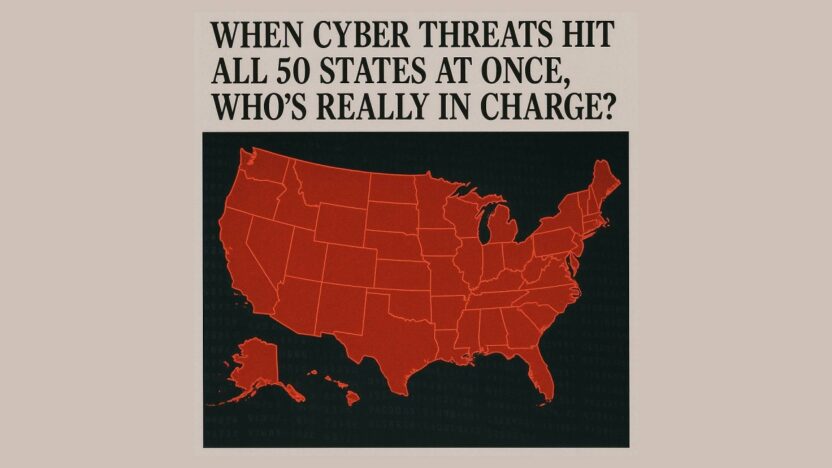
If you’re a CISO, state CIO, data-center engineer—or a security analyst who wears all three hats on Fridays—you’ve probably wondered:
“Can my state survive a nation-scale ransomware surge without a federal lifeline?”
📡 Four Flash-Point Facts You Can’t Ignore
• Ransomware triage: April 2024, A 911 outage occurred in multiple states, such as Nevada, South Dakota, and Nebraska. This outage was due to a severed fiber optic cable, not a cyberattack.
• State-sponsored probes: The United States power grid VPNs have been fully mapped by state-sponsored actors who amount to 70% of the total
• Funding cliff: The funding from FY-25 federal cyber grants decreased by 18% while attack volume increased by 42%.
• Legal lag: The Computer Fraud and Abuse Act which was enacted in 1986 is outdated enough to qualify for car rentals.
Translation: Our threat curve is exponential; our laws still think modems screech.
🏛️ Patchwork Today vs Partnership Tomorrow

Verdict: Flexibility is great—until it fractures.
🔑 4 Pillars of a National Cyber Resilience Act
- Minimum Security Standards All essential sectors need to fulfill NIST-aligned security requirements with no exceptions allowed.
- Guaranteed Funding Stream Multi- The combination of multi-year grants with performance-based bonuses creates stable budgets that enable equipment upgrades.
- Unified Intel Pipeline The system delivers IOCs directly to state SOC systems which avoid the multiple delays that occur when using six distribution lists.
- Shared Incident Command The incident response process during crisis situations will use a unified playbook and scoreboard while federal and governor representatives work together as equals.
Think FEMA for firewalls—muscle memory built before the breach.
🛠 Field Notes from the Data-Center Trench
I’ve watched tenants transform overnight when money + mandates aligned:
- Patch cycles shrank from quarterly to 72 hours.
- SOC headcount doubled—because budgets finally matched risk.
- Vendor roadmaps accelerated (hello, native SBOM support).
The lesson? Compliance is a tax—until everyone has to pay it. Then it’s an accelerator.
✨ Mic-Drop Truth
Cyber resilience isn’t red tape; it’s national security’s life support.
💬 Your Turn:
- Should Congress create an official Federal-State Cyber Defense Partnership through legislation?
- The security of voluntary frameworks together with their decreasing budgets remains sufficient for protection.?
👉 Drop your take below—agree, disagree, or propose a hybrid fix. Let’s crowd-source a safer future.
#CyberResilience #CISO #NationalSecurity #InfoSec #PublicPrivatePartnership
References:
- U.S. Government Accountability Office. (2023). High-Risk Series: Strengthening cybersecurity for the federal government. https://www.gao.gov/highrisk/strengthening-cybersecurity-federal-government
- Cybersecurity and Infrastructure Security Agency. (2024). State and Local Cybersecurity Grant Program (SLCGP). U.S. Department of Homeland Security. https://www.cisa.gov/safe
- Center for Strategic and International Studies. (2024). Significant cyber incidents since 2006. https://www.csis.org/programs/strategic-technologies-program/significant-cyber-incidents
- National Institute of Standards and Technology. (2023). Framework for improving critical infrastructure cybersecurity (Version 2.0). https://www.nist.gov/cyberframework
- U.S. Senate Committee on Homeland Security and Governmental Affairs. (2023, May 17). Examining cybersecurity resilience of state and local governments [Hearing]. https://www.hsgac.senate.gov/hearings/examining-cybersecurity-resilience-of-state-and-local-governments/