Introduction Artificial intelligence (AI) is revolutionizing cybersecurity, offering powerful tools for threat detection and risk mitigation. AI-driven solutions analyze vast datasets, identifying threats with greater speed and accuracy than traditional methods. Organizations leverage machine learning to automate threat detection, prevention, and response, enhancing security outcomes. Research shows that companies utilizing AI security measures detect and contain breaches significantly faster, reducing costs and mitigating damage.
However, AI also introduces new vulnerabilities. Experts emphasize the importance of securing AI systems against emerging threats. The concept of AI assurance—ensuring AI models are trustworthy, secure, and ethically aligned—is gaining prominence. This paper examines AI’s role in cybersecurity, focusing on adversarial attacks and healthcare regulations to ensure AI’s responsible implementation.
Adversarial Attacks: Explanation and Examples Adversarial attacks exploit AI model vulnerabilities, manipulating input data to deceive algorithms. Attackers introduce subtle modifications that mislead AI decision-making, known as adversarial examples. For instance, small stickers on a stop sign can cause a machine vision system to misclassify it, highlighting AI’s susceptibility to manipulation.
Types of adversarial attacks include:
- Modifying input at inference time to deceive AI classifiers, such as disguising malware as benign software.
- Tampering with training data to distort AI learning, potentially leading to misdiagnoses in medical imaging.
- Extracting sensitive training data or replicating proprietary AI models, compromising privacy and intellectual property.
- Manipulating AI language models to generate harmful or unintended responses.
These attacks have transitioned from theoretical concerns to real-world threats. The MITRE ATLAS framework catalogs known adversarial techniques, aiding cybersecurity professionals in mitigating risks.
AI-Driven Threat Detection and Defense Mechanisms Despite being a target, AI is instrumental in cybersecurity. Machine learning models identify anomalies, detecting unauthorized access or suspicious activity. AI enhances malware detection, analyzing patterns beyond conventional signature-based methods. AI-driven automation also enables rapid threat containment, minimizing response times.
To defend AI systems, researchers employ adversarial training—exposing models to manipulated data to enhance robustness. Collaborative efforts, such as Microsoft and MITRE’s Arsenal tool, simulate adversarial attacks to stress-test AI security. This proactive approach strengthens AI resilience, ensuring robustness against evolving threats.
Policy and Regulatory Frameworks in Healthcare AI’s integration into healthcare necessitates stringent regulatory measures. Medical AI applications, such as diagnostic tools and predictive analytics, require oversight to ensure accuracy and security. Regulatory bodies, including the FDA and HHS, are formulating AI-specific guidelines to uphold patient safety and data privacy.
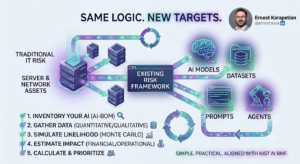
The U.S. National Institute of Standards and Technology (NIST) introduced the AI Risk Management Framework (AI RMF) to guide AI governance. Internationally, the European Union’s AI Act classifies AI by risk level, mandating stricter regulations for high-risk applications. Core regulatory principles include transparency, accountability, and continuous monitoring to safeguard healthcare AI deployments.
Case Studies: AI’s Role in Healthcare Cybersecurity
- Studies demonstrate that adversarial attacks can alter medical images, leading to misdiagnoses. Researchers have shown that subtle perturbations can deceive AI cancer detection models, underscoring the need for adversarial training and secure image authentication.
- In 2024, a healthcare provider suffered an AI-enhanced ransomware attack, where machine learning algorithms identified and encrypted critical patient data, evading detection. The incident highlighted the necessity for AI-driven security monitoring and real-time anomaly detection.
- Hospitals employ AI to analyze user behavior, identifying anomalies such as unauthorized data access. AI also secures medical IoT devices by detecting abnormal activity, preventing cyber intrusions.
Ethical Considerations and Future Directions Ensuring ethical AI deployment requires addressing bias, privacy, and accountability. AI models must be trained on diverse datasets to prevent discriminatory outcomes. Privacy safeguards, including encryption and access controls, are essential for handling sensitive healthcare data responsibly. Accountability frameworks must clarify liability for AI-driven security incidents, balancing automation with human oversight.
The cybersecurity landscape continues to evolve, with generative AI introducing new attack vectors. Research into AI alignment and validation aims to ensure AI security while preventing unintended consequences. Standardizing AI cybersecurity practices, including adversarial testing and lifecycle management, will be crucial for future implementations.
Conclusion AI is both a powerful tool and a target in cybersecurity. Its role in threat detection and response is invaluable, yet adversarial vulnerabilities must be addressed. A comprehensive approach—integrating technical defenses, regulatory frameworks, and ethical considerations—is essential for AI’s secure adoption, particularly in healthcare. By fostering collaboration between industry, academia, and policymakers, AI can be harnessed responsibly to enhance cybersecurity and protect sensitive data.